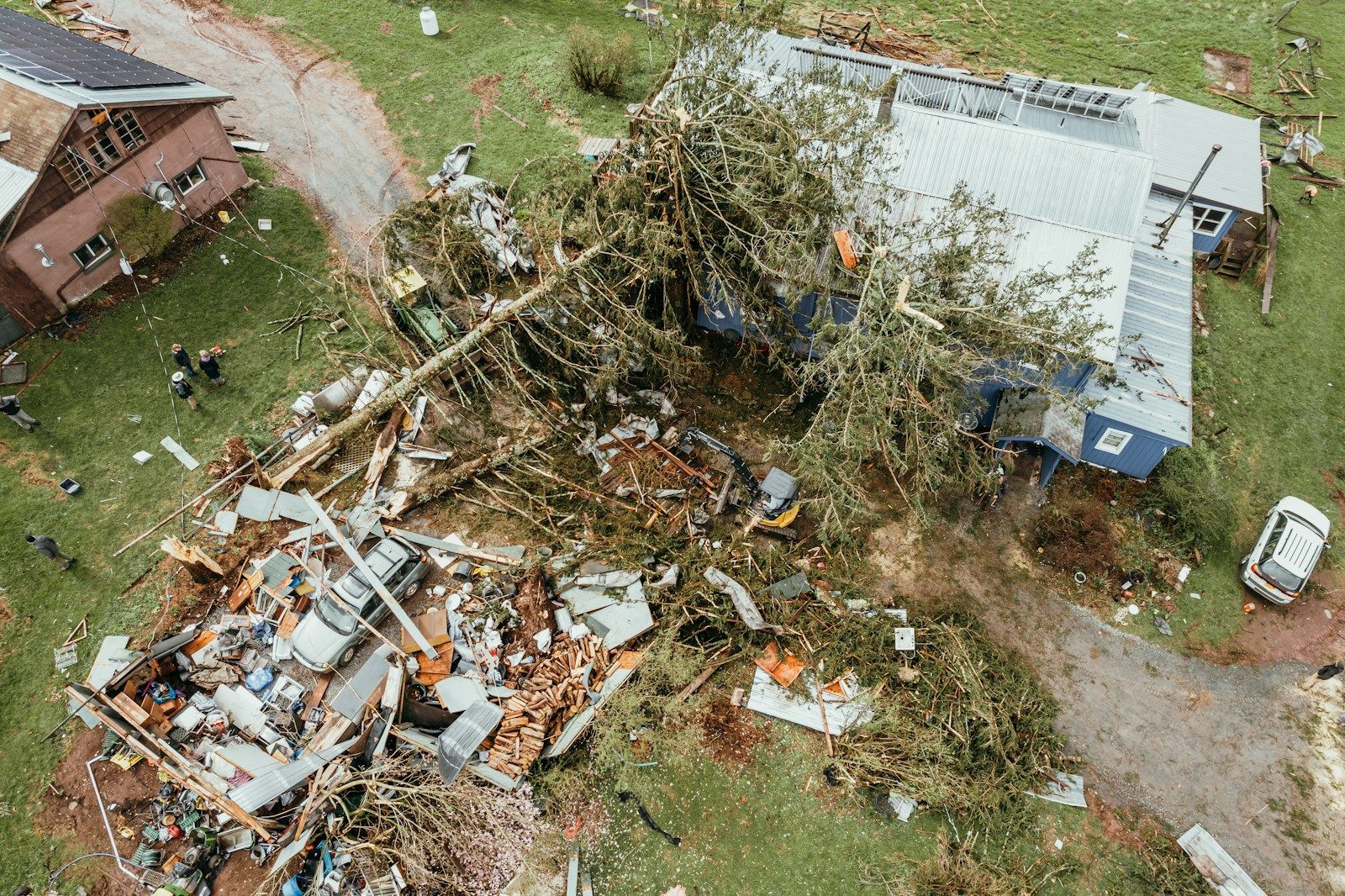
Short answer: A percentage deductible is a share of your dwelling coverage (Coverage A), not of the damage. With $300,000 of dwelling coverage and a 2% wind or hurricane deductible, you pay the first $6,000 of a covered storm claim. Many policies combine a flat deductible for most claims with a percentage one for wind, hail, or named storms.
How does a percentage deductible work?
A flat deductible is a set dollar amount, such as $1,000. A percentage deductible is a percentage of a number in your policy, and that number is your dwelling coverage, Coverage A. It is not a percentage of the damage. That one detail is where people get surprised. A 2% deductible on a $300,000 dwelling is $6,000 whether the storm causes $7,000 of damage or $70,000. You pay the first $6,000 of the covered loss, and the insurer pays the rest, up to your limits.
Many people find out about this after a storm, when the claim check is smaller than they expected or does not arrive at all because the damage was under the deductible. The best time to understand it is before the storm, on your declarations page. For how the rest of an HO-3 policy fits together, see our plain-English guide to what homeowners insurance covers.
Why do policies use two deductibles?
Most homeowners policies have one deductible for most claims, called the all-other-perils deductible, and a separate one for certain weather events, often wind, hail, or named storms. Insurers use percentage deductibles for storm risks because those losses can be large and widespread, and a percentage scales with the value of the home. In practice, it means a fire, a burst pipe, or a theft may carry a flat $1,000 deductible while a hailstorm or hurricane carries a percentage that is several times larger.
What triggers the separate deductible differs by insurer and state. It might be wind or hail damage, a storm that a weather service names, or a hurricane that meets a definition in the policy, such as a declared storm or a certain window of time. We are not giving specific rules because we could not verify them against an official source, so check your policy for the exact trigger, and ask your agent which of your claims would use which deductible. The declarations page lists them.
What does the math look like? A table
Here is the deductible in dollars for a range of Coverage A amounts and percentages. Each number is Coverage A times the percentage.
| Coverage A | 1% | 2% | 5% |
|---|---|---|---|
| $200,000 | $2,000 | $4,000 | $10,000 |
| $300,000 | $3,000 | $6,000 | $15,000 |
| $400,000 | $4,000 | $8,000 | $20,000 |
| $500,000 | $5,000 | $10,000 | $25,000 |
A few things stand out. The deductible rises when your Coverage A rises, even if you are happy with your policy. If you raise your dwelling coverage to keep up with rebuilding costs, a percentage deductible grows with it. And moving from 1% to 5% on a $400,000 dwelling takes the deductible from $4,000 to $20,000, which is a very different financial test after a storm.
Now put it against damage. With Coverage A of $300,000 and a 2% deductible, the deductible is $6,000.
| Covered storm damage | Deductible ($6,000) | Insurer pays | You pay |
|---|---|---|---|
| $5,000 | $6,000 | $0 | $5,000 |
| $9,000 | $6,000 | $3,000 | $6,000 |
| $20,000 | $6,000 | $14,000 | $6,000 |
| $60,000 | $6,000 | $54,000 | $6,000 |
Under $6,000, the claim pays nothing. Above it, you always pay $6,000 first. With a 1% deductible on the same home, the deductible is $3,000, and the $9,000 loss would pay $6,000 instead of $3,000. The difference is the reason to read the declarations page before the season starts.
How do you choose between a lower premium and a higher deductible?
Higher deductibles usually lower the premium, and lower ones raise it. The question is how much you save compared with how much more you would have to pay after a loss. As an illustration with made-up numbers: suppose moving from a 1% to a 2% wind deductible on a $300,000 home saves $250 a year in premium. The deductible goes from $3,000 to $6,000, which is $3,000 more at risk after a storm. At $250 a year, it would take twelve years of savings to cover that extra $3,000, if a storm claim happened. Whether that is a good trade depends on how likely a claim is in your area, how much cash you could pull together after a storm, and how you feel about risk. These figures are only a way to frame it; ask your agent for real quotes at each level.
A simple test is this: could you write a check for the full deductible on short notice, without borrowing at a bad rate? If not, a lower deductible might be worth the added premium. If you could, a higher one might save you money over time. A common approach is to keep a savings cushion at least equal to your deductible. We are not recommending a percentage, because the right one is personal.
Is a $5,000 deductible high?
It depends on what you compare it to. A $5,000 flat deductible is higher than many people choose for all claims, but it may be comparable to a 1% or 2% deductible on a moderate home, and lower than what a 5% deductible on a larger home would be. Context matters more than the number: your savings, your premium discount, your risk, and how often you expect to file. A $5,000 deductible may be fine for someone with savings who rarely claims and a poor choice for someone who would struggle to find $5,000.
| Situation | Possible outcome | Why |
|---|---|---|
| A burst pipe damages the kitchen | Usually the flat deductible | Most non-weather losses use the all-other-perils deductible, often a flat amount. Check your declarations page. |
| A hailstorm damages the roof | Often the wind and hail deductible | Many policies apply a separate, higher percentage deductible to wind and hail. See our hail damage guide. |
| A hurricane damages the house | Often a hurricane or named storm deductible | What counts as a hurricane or named storm depends on your policy’s definition, so read it. |
| Storm damage is $5,000 and your deductible is $6,000 | Covered, but pays nothing | A covered loss under the deductible pays zero. Compare before you file. |
| You raise Coverage A to keep up with rebuilding costs | Deductible rises too | A percentage deductible is calculated on Coverage A, so it grows with it. |
| You file a claim and the storm deductible applies | Depends | The insurer applies the deductible stated in your policy for that cause of loss. |
What happens if the damage is smaller than the deductible?
Nothing is paid, and you pay for repairs yourself. That does not mean you should not report anything, but it does mean you should think before you file. A claim that pays $0 can still be recorded, and some insurers count even claims that pay nothing. Our guide on premiums after a claim explains how claims history works. Before you file, get a contractor’s estimate, compare it with your deductible, and use the claim calculator to see the premium effect. If you are only asking questions, say so at the start of the call.
What is the 80% rule, and how does it connect?
Many policies that pay replacement cost on the dwelling require you to insure it for at least 80% of its replacement cost. If you carry less, a partial loss may be paid at a reduced share, even before the deductible. As an illustration with made-up numbers: suppose your house would cost $400,000 to rebuild, so the 80% threshold is $320,000, and you carry $240,000. That is 75% of the required amount. A $20,000 loss might be paid at 75%, or $15,000, before the deductible comes off. A percentage deductible makes it matter twice, because a higher Coverage A raises both your protection and your deductible. Check the loss settlement terms in your policy, and see our guide on foundation repair, which covers the 80% guideline in more detail.
How much dwelling coverage do you need, really?
Dwelling coverage is meant to rebuild the house, not to match its market price. Land is not part of it, and construction costs vary by area and over time. Ask your agent for a replacement cost estimate, look at it each year, and remember that whatever number you choose is also the number a percentage deductible uses. We are not giving a per-square-foot figure because we could not verify one.

What should you ask your agent at renewal?
The declarations page tells you the numbers, but a few questions fill in what it leaves out. Ask which perils use the percentage deductible and which use the flat one. Ask whether the percentage applies to your dwelling coverage only, or to other coverages too. Ask whether the deductible applies once per storm or once per policy year, and what happens if two storms hit in one season. Ask how the policy defines a named storm or a hurricane, and whether anything has to be declared by an agency before the deductible applies. Ask what changes if you raise or lower the percentage, and what the premium difference is at each level. Finally, ask whether your Coverage A will change at renewal, because a percentage deductible moves with it. Write the answers down and keep them with your policy, so a surprise after a storm does not become the first time you read these terms.
A percentage deductible can also interact with other terms in the policy. If your roof is paid at depreciated value, for example, the depreciation comes off first and the deductible comes off after, so a larger deductible compounds the effect. Our guide on old roofs and insurance shows how that arithmetic works, and the hail damage guide shows how it plays out in a typical storm claim.
What to do before storm season
Know your deductibles before the storm
- Open your declarations page and write down every deductible: the all-other-perils deductible and any wind, hail, hurricane, or named storm deductible.
- For each percentage deductible, multiply it by your Coverage A to get the dollar amount. Do the arithmetic yourself and check it with your agent.
- Ask which causes of loss trigger each deductible, and what the policy’s definition of a named storm or hurricane is.
- Compare quotes at two or three deductible levels, and ask how much premium each saves.
- Decide how much cash you could pay after a loss, and consider setting that amount aside.
- Ask whether your Coverage A is enough to rebuild, and whether you meet the 80% condition if it applies to your policy.
- After any loss, compare a contractor’s estimate with the right deductible before you file. Our guide to filing a homeowners claim explains the next steps.
Two real scenarios
The hailstorm. Ines has a $300,000 dwelling and a 2% wind and hail deductible, and hail damages her roof. Her roofer quotes $9,000. The deductible is $6,000, so the claim pays about $3,000. Because she checked her declarations page, she is not surprised, and she compares the payout with the premium effect before deciding. She also asks about recoverable depreciation, which our hail damage roof guide explains.
The surprise. Paul sees “2% hurricane deductible” on his renewal and assumes it is $2,000 because his old deductible was a flat $1,000. After a storm, he learns it is 2% of his $400,000 dwelling, which is $8,000. His damage is $7,500, so the claim pays nothing. Had he multiplied it out at renewal, he could have chosen a different level or set money aside.
Save the declarations page that was in force on the date of the loss. It shows the dwelling coverage and deductible percentage you need to check the insurer’s calculation against your claim.
For related topics, see the Claims & Deductibles category.
Frequently asked questions
What is a good deductible percentage for home insurance?
There is no single good number. A lower percentage costs more in premium but leaves less to pay after a storm, and a higher one saves premium but needs more cash on hand. Pick the percentage by working out the dollar amount on your own Coverage A and asking whether you could pay it tomorrow.
Is a $5,000 deductible high for homeowners insurance?
It depends on your situation. Compared with a typical flat deductible it is on the higher side, but it can make sense if the premium savings are meaningful and you have cash set aside to cover it. The test is whether you could pay that amount after a loss, and whether the savings over several years justify the risk.
What is the 80% rule in homeowners insurance?
Many replacement cost policies require you to insure the dwelling for at least 80% of its replacement cost. If you carry less, a partial loss may be paid at a reduced share instead of in full, even before the deductible. Check the loss settlement terms in your policy and ask your agent whether your Coverage A is high enough.
How much home insurance do I need for a $400,000 house?
It is not about the price of the house. Dwelling coverage should reflect what it would cost to rebuild, which excludes the land and can be higher or lower than the market price. Ask your agent for a replacement cost estimate, and remember that a percentage deductible will be based on that Coverage A.
Sources
- How property deductibles work — Resolution Claims
- A Consumer Guide to Homeowners Insurance — Maryland Insurance Administration
- A Consumer's Guide to Home Insurance — National Association of Insurance Commissioners
- Homeowners 3 — Special Form, ISO form HO 00 03 05 11 — Maine Bureau of Insurance
CoverClaro explains insurance. We do not sell insurance or give personal advice. Your policy and insurer determine your coverage.